

The first moment I saw Wild Blue Skies, it was hard not to think about Star Fox.
Nintendo’s often ignored on-rails space dogfight shooter is the gold standard when I think of old school on-rail shoot-em ups. My dad and I played through Star Fox 64 so often it became a weekend ritual to see how fast we could go through the upper hard route. Sadly, subsequent Star Fox games failed to capture the highs of that seminal Nintendo 64 entry. I’ve always wondered if it was just a victim of its time, or just my nostalgia bubbled up in that period.
When I heard Wild Blue Skies developer Chuhai Labs was being headed by a former Nintendo programmer who worked on the original Star Fox, my interest was piqued. Suddenly, any cheeky, mean spirited thought of “hey, someone’s doing Star Fox by way of Temu” subsided knowing someone who worked on the original recipe basically went “fine, I’ll do it myself”. After an almost decade long dormancy with Nintendo not doing anything with that franchise, I loved that someone was gonna try to do this kind of game at least.
While I can’t imagine way worse timing than releasing right after Nintendo shocked everyone with a surprise announcement and quick release of a remake of the Star Fox game I love the most, I was still eager to see how Wild Blue Skies would turn out. Now there was actual competition in this space, and I wanted to see what a non-Nintendo made game in this style was like, particularly one releasing multi-platform. With that in mind, did Chuhai Labs pull off the trick?
YOU’LL NEVER DEFEAT GRIMCLAW
The setup for Wild Blue Skies is simple: a once decorated engineer named Grimclaw turned evil and was sent into exile by a group of dogfighters called Blue Bombers. Years later, Grimclaw strikes back with a vengeance, and its up to a new group of Blue Bombers led by a new cadet named Bowie to take the fight back to Grimclaw and bring back peace to the planet.

Tweak a few things, and you can tell that the whole setup for Wild Blue Skies is a slight play on the setup for Star Fox 64. They say “imitation is the sincerest form of flattery”, and while I don’t know how much that applies here with the fact someone who worked on that series worked on this, it really is hilarious the way Wild Blue Skies tempts fate by lifting scenarios straight from that 1997 classic. A first level with a specific obstacle course that unlocks a second pathway through the world map. A third mission where you face off against a rival squad in open air field. A final boss that’s a literal head with floating hands. So much of this game really pushes the boundaries of “flying too close to the sun”.

While so many of these similarities to Star Fox are blatant to the point of self parody, thankfully the cel-shaded aesthetic works extra hard to at least give Wild Blue Skies its own sense of identity. The game limits its scope to just one planet, but it still allows the different levels to at least have their own flair. From going through canyons, hurricanes, deserts, and different levels of blizzard storms, there are moments in Wild Blue Skies that tell me Chunai Labs understands how to create levels that understand the appeal of this style of on-rail shoot-em-ups, and its definitely at its strongest when I don’t immediately recognize something as a riff on Star Fox. It tells me they have it in them to do more original stuff without living in the shadow of its inspiration.
DO A BARREL ROLL
For the most part, Wild Blue Skies nails its combat fundamentals. There is a certain snapiness to the dogfighting where I immediately felt at home from minute one. Your basic arsenal of regular laser blasts, charge blasts, bomb deployment, and dual barrel roll are here, and it didn’t take long for me to start trying to rack up the high scores in the game’s 13 stages. With that said, I actually was surprised how challenging the game could get at times, where the game overwhelms you with so many enemies shooting at you that its a necessity to constantly do dual barrel rolls or your risk ruining the “no damage” runs. And its in those areas where I did start finding some specific issues.
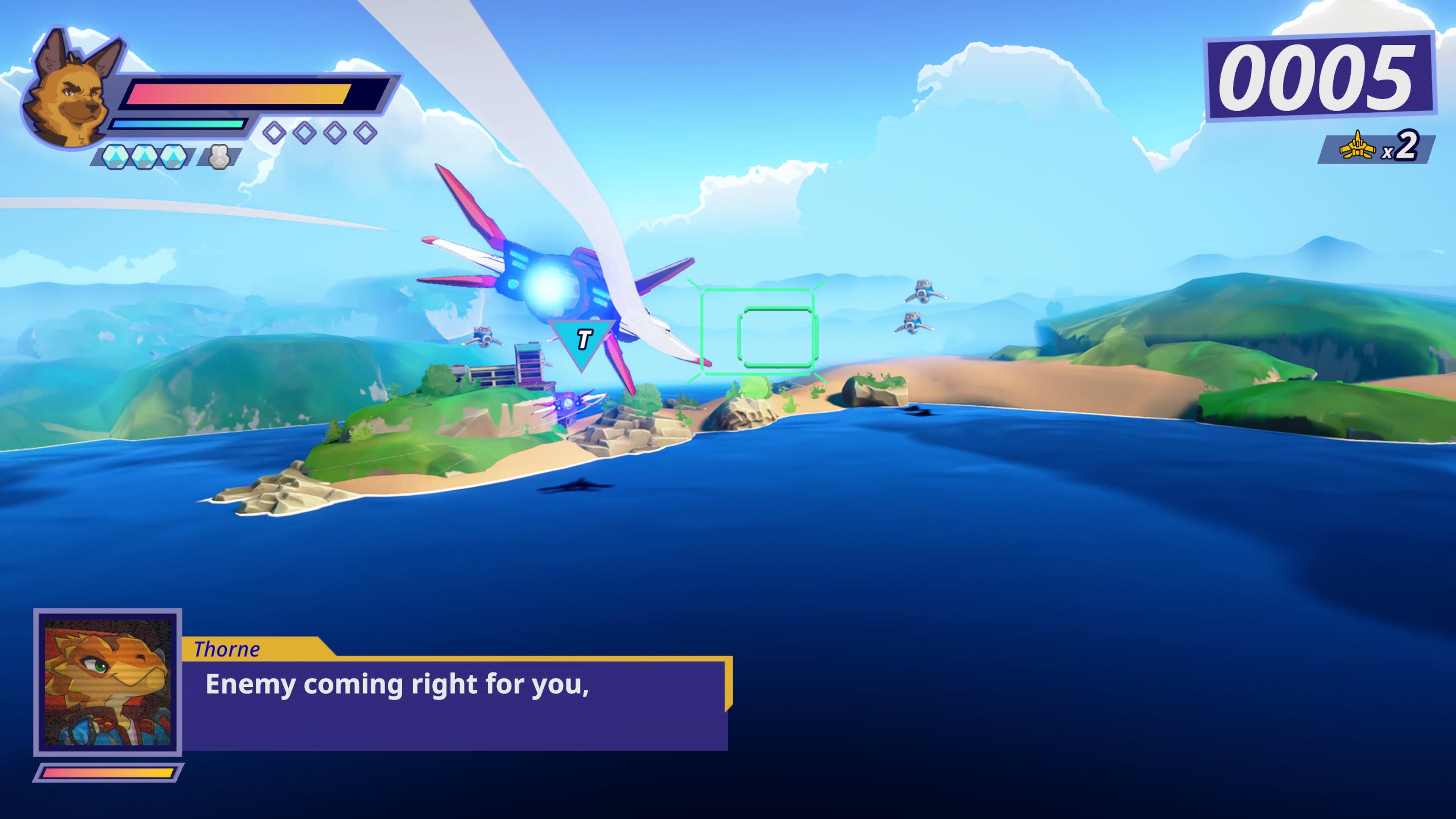
For a game that nails so many combat fundamentals, missing little polish details holds the game back. The game is both snappy and floaty, and that floatiness can sometimes come back to bite you as it really makes things like speed breaking feel completely useless as a mechanic if you’re trying to nail something in a level that’s about to pass you by. There is an emphasis in trying to get the laser upgrades as soon as you see them in a level, but it has come at the expense of making your basic laser feel like it does peanut damage. And if you somehow die late in a level and you got a checkpoint where you know there are no further upgrades to get, you are completely SOL, and it will make finishing some of the levels feel more laborious when you barely are doing any damage. This can be softened if you enable automatic fire in the options menu, which allows your basic attack to get some of that oomph back with a more consistent barrage of shots.

It’s those tiny missing details that threaten to stack up against the things the game does well. I appreciate the game takes the same design ethos from Star Fox of fulfilling a secret objective within a level that will open the pathway for other stages, which is a boon for replay value for a game that can be completed in less than 2 hours for one run. Unfortunately, where Star Fox sign posts and gives an idea without outright telling you what those objectives can be, Wild Blue Skies is wildly inconsistent in this department, where one level can actually be pretty obvious on what needs to be done (the aforementioned first level’s obstacle course), but then you go into a level where not even a single line of dialogue or visual cue will tell you what can trigger the objective, which can be frustrating when you get overwhelmed in your senses and you’re trying to open up that pathway to the other levels. This was just one polish pass away from nailing this, and I hope if they get another chance to do another game they put more focus on those little details when they’ve nailed a lot of the basic fundamentals so well already.
Like I mentioned previously, the game’s cel-shaded art style really does a lot of the heavy lifting for the game. Even with some low-res textures here and there, the look of the game can be very distinct and shines the brightest when more particles are flying on the screen. But the framerate I find confusing, where it mostly maintains a rock solid 60fps on the PlayStation 5 version I played before tumbling down to the low 20’s in specific levels. If I’m perfectly honest, it doesn’t make sense why the performance would take a hit compared to other times it holds steady because I don’t see a difference in detail and particles flying at you. Once again, just small details that do chip damage to a game that nails it elsewhere.
Timing is everything, and I wish I lived in a world where Wild Blue Skies had released as it was intended to be: the answer to a lack of Star Fox or any kind of on-rails shoot-em ups in the market. While no fault of their own that Nintendo suddenly woke up and released an actually great remake of what people consider the gold standard for this kind of game, I still want to commend Chunai Labs for taking the initiative and giving an honest attempt.
To their credit, Wild Blue Skies understands the fundamentals of what makes this genre tick, and I mostly enjoyed the time I got to spend with it, brief as it were. Perfect should never be the enemy of good, and even with some lacking polish in small key areas, I see great potential if they ever gave this another go. As it is, if you are hungry for this kind of game, unless you’re strictly in Nintendo’s camp, I can imagine this briefly satiating the hunger.

Thank you to our PR partners and Chunai Labs for review access to Wild Blue Skies. You can find Seasoned Gaming’s review policy here.


